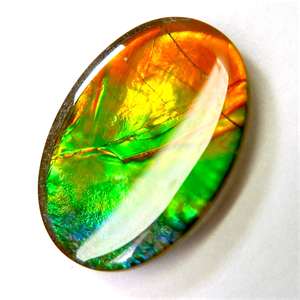

Ammolite is a rare and valuable organic gemstone similar to Opal. It is found in the eastern slopes of Rocky Mountains of North America. It is made of the fossilized shells of Ammonites. This in turn is made up of aragonite – the mineral that makes up the nacreous pearls. It is one of the biogenic gemstones. In 1981, the World Jewellery Confederation gave ammolite the official status of a gemstone. In the same year commercial mining of ammolite began.
Ammolite is also known as aapoak or “small, crawling stone”, gem ammonite, calcentine, and korite. The last name is a trade name given to the gemstone by the Alberta-based mining company – the first and largest commercial producer of ammolite called Korite International.
The quality of gem ammolite is conveyed using a letter grade system, from most desirable to least desirable: AA; A+; A; and A-. However, this system is not yet standardized and some vendors may use their own systems. The grade and therefore the value of an ammolite gemstone is determined by the following criteria:
The number of primary colors: A large array of color is displayed in ammolite, including all the spectral colors found in nature. Red and green are far more common than blue or purple. Primary colors may combine to give out certain hues, like crimson, violet or gold. The most valuable grades have roughly equal portions of three or more bright colors or 1–2 bright and even colors. The lowest grades have one predominant dull color.
Chromatic shift:
The variation of colors with the angle of viewing and the angle at which light falls on the gemstone is known as chromatic shift. In higher grades this variation is almost similar to the spectrum formed by the prism. In the lower grades show very little variation.
Rotational range:
Rotational range is how far the specimen can be turned while maintaining its play of color. The best grade can be rotated by 360 degrees. The lesser stones may exhibit colors that are only visible within a narrow rotational range say 90° or even less. Intermediate grades have ranges of 240–180°.
Brightness of colors (iridescence)
The brightness of colors is essentially dependent on how well-preserved the nacreous shell is, and how fine and orderly the layers of aragonite are. The quality of the polish is also a factor. The most prized ammolite is the sheet type which has broad, uninterrupted swathes of color similar to the “broad flash” category of opal. The matrix is not visible in finer grades, and there should be no foreign minerals breaking up or diminishing the iridescence.
The thickness of the ammolite layer is also an important factor: after polishing, the ammolite is only 0.1–0.3 millimeters thick. The rarest and most valuable are thick enough to stand alone, but the vast majority require some sort of supportive backing.
When all the other factors are equal, the less treatment an ammolite gem has received, the more valuable it is. Due to its fragility ammoloite is best suited for making brooches, pendents and earrings. Whole polished ammonites of appropriately small size may also be mounted in jewelry. Nothing harsher than mild soap and warm water should be used to clean ammolite jewelry.